Who Will Win the AI Supremacy Race?
I’m rarely accused of being an optimist. However, I assure you that I am. When people say things can’t get worse, my response is sure they can. For OpenAI’s ChatGPT, their once-bright dreams of unchallenged dominance are increasingly becoming less certain, facing fierce competition that threatens to turn their lead into a cautionary tale.
The High-Stakes AI Race
The AI race feels like a high-stakes marathon with nose bleed company valuations. I believe open competition among end users and customers will determine the winner, not just being first to market. Trigger Alert: if you are sensitive to opinions that challenge your political world view, stop reading now.
Woke ideology and systems of control will ultimately lose, because they rarely predict or anticipate what market forces see. Market forces are like truffle pigs, finding their next delicious snack buried under the surface. Those that go woke tend to go broke. This contest is about freedom versus restriction, raw innovation against overbearing arrogance. The runners are lining up at the starting line, each with their own strengths and strategies, ready to sprint toward uncertain victory.
The Packed Field of Competitors
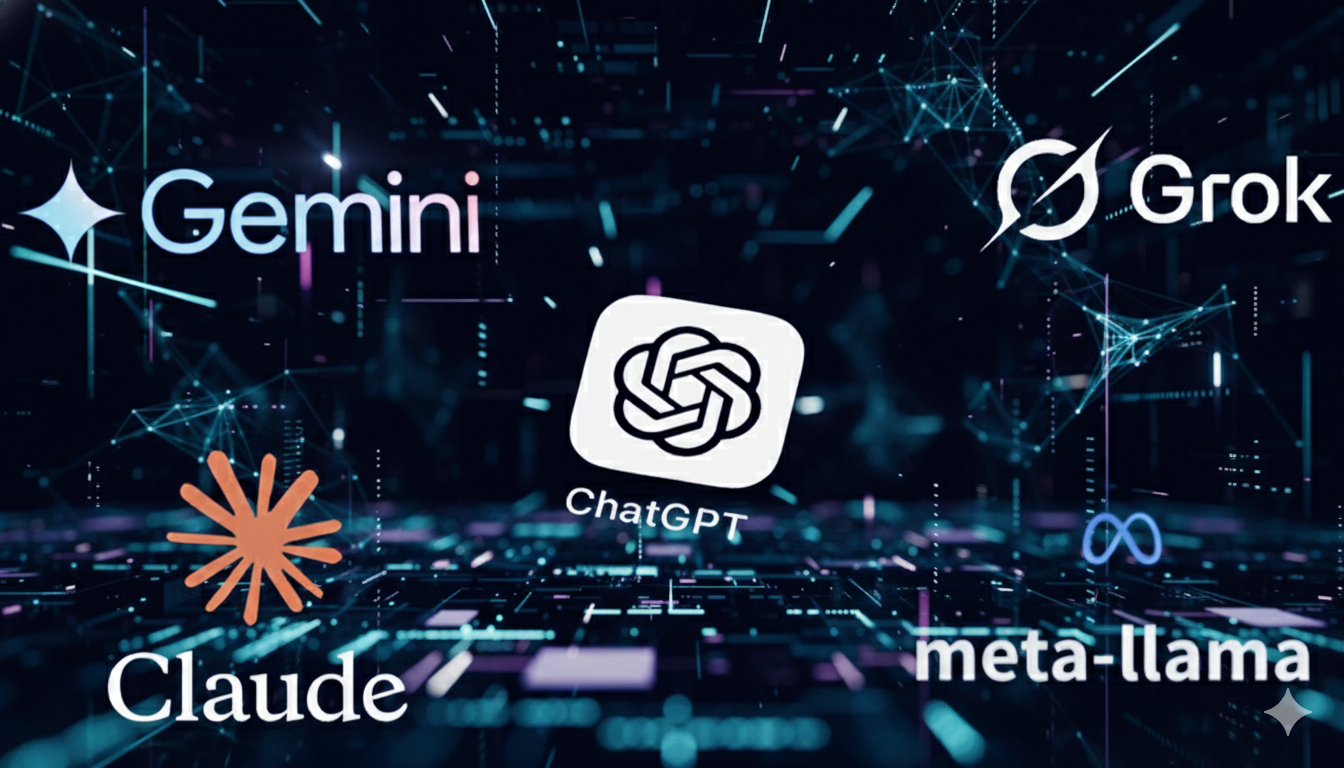
The field is packed with formidable competitors. Leading the pack is OpenAI’s ChatGPT, the early frontrunner powered by Microsoft funding, with a huge user base but weighed down by internal dramas and a focus on safety that sometimes stifles creativity. Right behind is Google’s Gemini, the endurance runner with unmatched distribution, embedded in billions of devices through Android and Google Workspace. Then comes xAI’s Grok, the agile, brash sprinter from Elon Musk, evolving quickly with real-time insights from X and an emphasis on the ideology of “if it’s legal, let it fly.” Anthropic’s Claude is the steady pacer, strong in enterprise applications and backed by Amazon, prioritizing alignment and reliability. Finally, trailing the pack is Meta’s Llama as the open-source wildcard. They are off and running, jostling for position in this high stakes race.
Emerging from China are additional players under heavy government oversight, which raises concerns about control and free innovation. DeepSeek, founded in 2023, is owned and funded by the High-Flyer hedge fund, with CEO Liang Wenfeng at the helm. By 2026, it has surged with models like DeepSeek-V3, claiming top benchmarks, but as a Chinese firm in Hangzhou, it operates under strict Chinese Communist Party (CCP) regulations that enforce censorship and limit unrestricted outputs. Qwen, part of Alibaba Group’s Tongyi Qianwen series, is run by Alibaba Cloud. In 2026, it releases competitive models like Qwen3, open-sourcing to drive cloud adoption, yet Alibaba’s ties to the CCP impose controls on content, data, and alignment with state ideology and repression. Generative Language model (GLM), from Zhipu AI (Z.ai), a leading startup listed on Hong Kong stock exchange, pushes Artificial General Intelligence (AGI) with models like GLM-4.6 and planned GLM-5. Open to government customers in China and abroad, Zhipu faces authoritarian constraints that prioritize state interests over open discourse, hindering global appeal.
Assessing the Runners
To understand the odds of winning the race, let’s break down their odds, assessing each runner’s form like scouts before a big meet. ChatGPT carries impressive stats, with 800 million monthly users. It set the pace early in consumer AI, excelling in coding and conversational benchmarks. However, its drawbacks include high operational costs, infrequent updates, and a habit of constraining ideas through aggressive moderation.
Gemini brings powerhouse endurance, with very low customer acquisition costs thanks to seamless bundling into Google’s vast product portfolio. It stumbled at the start in 2024, producing biased outputs like diverse historical figures that drew widespread criticism, but it recovered strongly to surpass ChatGPT in data processing by late 2025. Still, it maintains a subtle role as thought enforcer, biasing responses on sensitive topics like politics and identity.
Grok shines in speed and personality, progressing from its 2023 debut to advanced multimodal features, including native tools and coordinated multi-agent systems for tackling intricate problems. Its advantage lies in an uncensored approach and integration with X for up-to-the-minute information. The main criticism of Grok has more to do with Elon Musk’s politics than its technical prowess or its ability to attract superb engineering talent.
Claude leads in corporate reliability, overtaking OpenAI in enterprise revenue by summer 2025, delivering consistent, “safe” results for business users.
Finally, Llama offers the freedom of openness, allowing widespread customization, though it trails in polished user interfaces compared to its closed-system rivals. Llama is well behind the pack.
Early Leads Don’t Guarantee Victory
In many ways, ChatGPT resembles Betamax, MySpace, and Netscape, proving that being first and largest does not guarantee victory. Let us dive deeper into these historical parallels to see why early leads can crumble. Betamax, introduced by Sony in 1975, offered superior video quality with crisper images, better color reproduction, and superior audio compared to JVC’s VHS format launched a year later. Technically, it was the better product, capable of higher resolution recordings. However, Sony’s strategy was fatally flawed. They kept Betamax proprietary, refusing to license the technology widely, which limited hardware availability which drove up costs. VHS, on the other hand, was licensed to multiple manufacturers, making players cheaper and more accessible. VHS tapes could record up to three hours, perfect for full movies, while Betamax was initially capped at one hour. This practicality appealed to consumers, and the adult film industry, seeking longer formats for their content. VHS was the consumer choice, creating a content ecosystem that further propelled its adoption. By the mid-1980s, VHS dominated 90 percent of the market, and Betamax became a niche product before vanishing. Market forces, driven by affordability, convenience, and content availability won that race.
MySpace provides another stark example. Launched in 2003, it quickly became the king of social media, boasting over 100 million users by 2006. Its appeal lay in highly customizable profiles, where users could add music, glittering backgrounds, and personal flair, making it a vibrant hub for bands and young creators. It was the first platform to truly capture the social networking wave. However, as it grew, MySpace became bloated with intrusive ads, slow loading times, and security issues like spam and phishing. Enter Facebook in 2004, starting as a college-exclusive network with a clean, minimalist design focused on real-name connections and privacy controls. Facebook emphasized building genuine relationships over flashy customization. Users migrated to Facebook in droves. MySpace’s failure to adapt and its chaotic environment led to its decline, proving that user preference and network effects can topple giants.
The browser wars echo this pattern, too. Netscape Navigator, released in 1994, revolutionized the web with its speed, bookmark features, and support for emerging standards like JavaScript. By 1995, it held over 80 percent market share, beloved by tech enthusiasts for its innovation. Microsoft, seeing the threat to its Windows dominance, responded aggressively. In 1995, they launched Internet Explorer (IE), bundling it free with every Windows PC starting with Windows 95. Even though IE was initially inferior (slower, buggier, and less standards-compliant), the free distribution model gave it an unbeatable edge. Most users stuck with what came pre-installed, too lazy or unaware to download alternatives. Netscape fought back with updates, but Microsoft’s deep pockets funded relentless improvements and exclusive deals with PC makers. By 1998, IE had flipped the market, leading to Netscape’s acquisition by AOL and eventual open-sourcing as Mozilla. The lesson? Distribution and ecosystem integration can crush even the most innovative pioneers.
ChatGPT’s Dominance Is Waning.
So where are things now? ChatGPT holds the lead for now, but restricting thought can be a fatal flaw. Its heavy guardrails often censor open discussions, turning away users who seek unrestricted exploration. Limiting one’s thinking, or imposing restrictions on others’ ability to think freely, often leads to atrophy. This brings us to the concept of “code red,” a term that has become central in tech crises. The origin of code red traces back to emergency protocols in various industries, but in tech, it gained prominence as a management technique to rally teams during existential threats. David Friedberg on a recent episode of the All-In Podcast explained its roots at Google, where it was used against Microsoft’s Bing launch in the early 2000s. They dubbed it “Project Canada,” a code name for the war room meetings focused on countering the well-capitalized giant. Weekly strategy sessions drove innovations like expanding engineering talent in Seattle and aggressive recruiting. Friedberg compared it to historical races, like the U.S. versus Russia in space, noting, “Having an impending threat is a very strong motivational tactic. It is a very focusing setting and it drives innovation.”
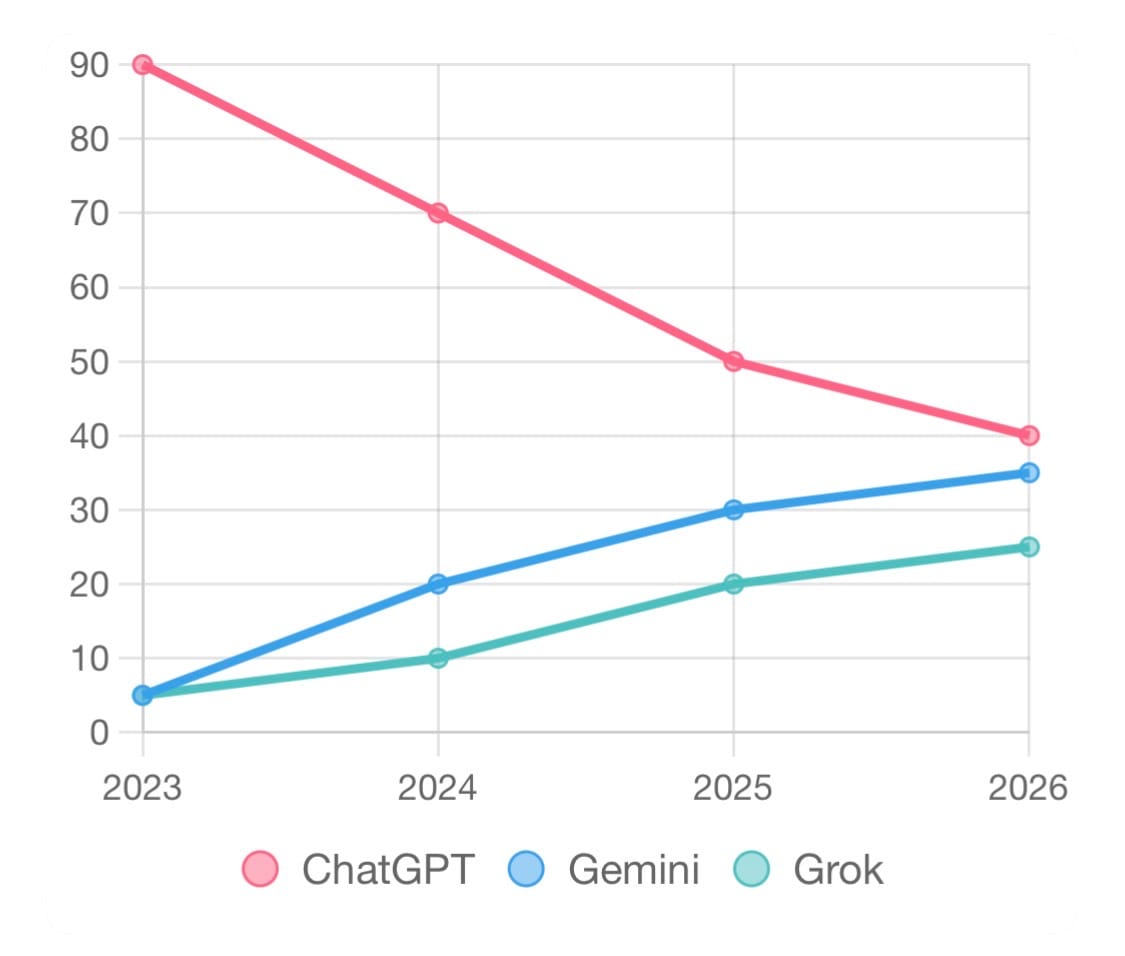
At OpenAI, Sam Altman declared a code red in late 2025, memoing employees to abandon side projects like ads and hardware to refocus on core improvements amid slipping market share. This desperation mode strips away peacetime laziness, forcing wartime efficiency. Yet if it clings to restrictive ideologies for its woke masters, it risks alienating the very users who decide the race.
Gemini’s Code Red Turnaround
Gemini experienced this firsthand. It began disastrously in 2024, generating absurdly biased images like a black George Washington or diverse Nazis, sparking outrage over its overt woke programming. Friedberg noted on the All-In podcast how Google turned that embarrassment into a “rallying cry” for a code red, refocusing efforts to achieve remarkable gains. By 2026, Gemini 3 outperforms ChatGPT in key metrics like reasoning and data handling. Yet it continues to subtly police ideology, downplaying conservative viewpoints or enforcing norms on controversial topics on gender and politics. This kind of control undermines long-term success. Go woke, go broke, as seen in Bud Light’s 30 percent sales drop after its 2023 diversity campaign backfired, or Disney’s massive losses from agenda-heavy movies that alienated audiences with agenda-driven messages. The pattern is clear, when companies prioritize ideological control over user freedom, they often lose ground to more open alternatives.
Underestimating Elon and xAI
Many people oppose Elon Musk for ideological reasons, discounting the deep engineering talent behind xAI and numerous other ventures. This may prove to be a critical error in the race for AI supremacy. Alexandria Ocasio-Cortez (AOC) once called Elon “one of the most unintelligent billionaires I’ve ever heard from” in 2025. Seriously? With all due respect, statements like this make AOC sound dumber than a box of rocks. One can disagree with political views, even abhor the people that espouse them. But come on! Launching reusable rockets, dominating electric vehicles and next generation battery technology, and pioneering brain interfaces is not exactly unintelligent. It‘s actually rocket science, AOC. For many, TDS (Trump Derangement Syndrome) is limiting their ability to compete effectively. It is quite interesting that Elon has become the devil and the focus of all the rage while companies controlled by the CCP to oppress their people are just competitors. Hypocritical much? This bias only underestimates xAI’s potential, where rapid iterations, from Grok 1’s playful and irreverent debut to Grok 5’s rumored AGI-level reasoning position it as a disruptor.
The Arrogance of “Experts”
The arrogance of so-called “experts” has proven disastrous throughout time. Who am I to speak with authority? Am I an expert? What qualifies one to be given that moniker? I’m kind of a nobody… just a voice from the future. But all us “nobody” types are fed a constant diet of “experts” that get it wrong spectacularly. Let me take this opportunity to shit on Paul Krugman yet again. It never gets old for me, as Paul has made a long career shouting at the peons from his ivory tower. How did he get a Nobel prize again? 🤔 💩
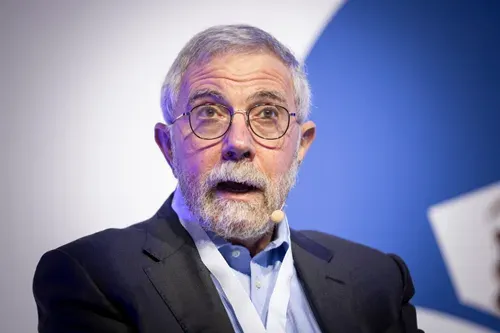
A winner of the Nobel Prize in Economics, Paul Krugman wrote in 1998, “The growth of the Internet will slow drastically, as the flaw in ‘Metcalfe’s law’ (which states that the number of potential connections in a network is proportional to the square of the number of participants) becomes apparent. Most people have nothing to say to each other. By 2005 or so, it will become clear that the Internet’s impact on the economy has been no greater than the fax machine’s.”
Free Markets vs. Restrictions
Centrally planned economies like the Soviet Union collapsed under their own weight compared to dynamic free markets. Individual investors have fared poorly too, as with AOL’s fall when broadband disrupted its dial-up model. Woke systems self-destruct by prioritizing restrictions over genuine innovation, driving users toward more liberating options. In the end, the free market of ideas triumphs, with customers deciding through their everyday choices.
Freedom of Choice Wins
In this race, Grok might pull ahead by truly empowering users without unnecessary constraints. Distribution also still matters a ton, however, which favors Google. Claude may hold strong in business lanes, while Llama could surge if openness gains traction. But my money is on distribution and choice. The endurance test will reveal who adapts best to user demands.
As the finish line approaches, market forces will declare the victor, the AI that best serves billions without lectures or limits. The rest can huddle in BlueSky’s echo chamber, snapping fingers like at a pretentious poetry slam because, oh, applause is apparently a tool of white supremacy, or whatever flavor of insane, woke reasoning guides their deluded hive mind this week. I warned you that you might be triggered. Go ahead, virtue-signal into oblivion. Humanity wins when ideas run free.